
5K Training Plan: The Complete Guide for Beginners to Advanced Runners
Running a 5K is one of the most popular goals for runners around the world. The distance is short enough for beginners, yet challenging enough for experienced runners who want to improve their speed. If you want a personalized schedule based on your fitness level and training availability, you can generate your personalized 5K training plan here.What You’ll Learn
What Is a 5K?
A 5K race is 5 kilometers (3.1 miles) long. If you’re new to running, you may want to start with a 5K training plan with only three runs per week, which is ideal for beginners and busy schedules.- Beginner runners: 30–40 minutes
- Intermediate runners: 22–30 minutes
- Advanced runners: under 20 minutes
How Long Should You Train for a 5K?
Most runners need 6 to 12 weeks to prepare for a 5K race. If you’re starting from zero, a structured 8 week 5K training plan is one of the most effective ways to build endurance safely.Beginner runners
- build consistent running habits
- improve aerobic fitness
- gradually increase distance
Intermediate runners
Runners who can already complete a 5K may benefit from a 6–8 week training cycle.Advanced runners
Experienced runners often follow shorter, more intense training blocks. If you’re unsure how long to train, read our detailed guide: How long does it take to train for a 5K?.Key Workouts in a 5K Training Plan
A good 5K training plan includes several different types of runs.Easy Runs
- build aerobic endurance
- improve running economy
- support recovery
Long Runs
- improve endurance
- increase fatigue resistance
- strengthen connective tissue
Interval Workouts
- 400 meter repeats
- 800 meter repeats
- hill intervals
Tempo Runs
- 15–25 minutes
- or 3–5 kilometers

Example Weekly 5K Training Schedule
- Monday: Rest or cross-training
- Tuesday: Easy run – 4 km
- Wednesday: Rest
- Thursday: Interval workout – 4 × 400 meters
- Friday: Rest
- Saturday: Easy run – 3 km
- Sunday: Long run – 6 km
Example 8-Week 5K Training Plan
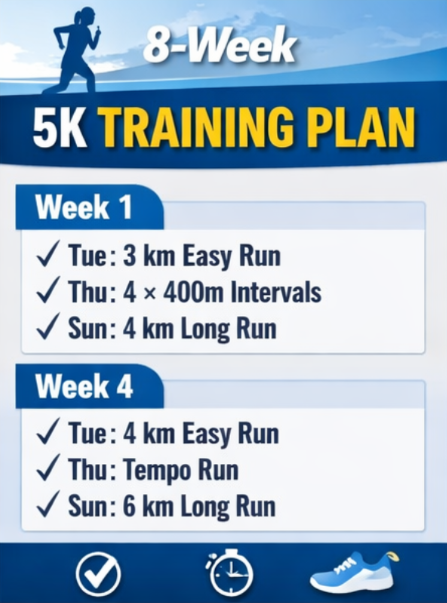
Most effective training plans follow the principle of progressive overload, gradually increasing training stress so the body adapts. This principle is widely supported by research published by the National Strength and Conditioning Association. Below is a simplified progression for a typical beginner training cycle.Week 1
Tuesday – 3 km easy run Thursday – intervals (4 × 400m) Sunday – 4 km long runWeek 2
Tuesday – 3 km easy Thursday – tempo run Sunday – 5 km long runWeek 3
Tuesday – 4 km easy Thursday – intervals Sunday – 6 km long runWeek 4
Tuesday – 4 km easy Thursday – tempo run Sunday – 6 km long runCommon 5K Training Mistakes
Running Easy Runs Too Fast
- fatigue
- injury
- reduced performance
Increasing Mileage Too Quickly
Increase weekly mileage by no more than 10%.Skipping Recovery Days
Recovery allows your body to adapt to training.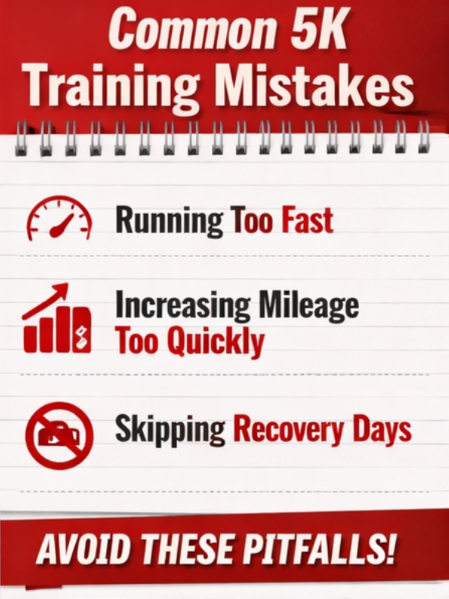
Race Strategy for a 5K
- First kilometer slightly controlled
- Middle kilometers at target pace
- Final kilometer maximum effort
Generate Your Personalized 5K Training Plan
Instead of following a generic training schedule, create a plan tailored to your goals.- your current running level
- how many days per week you can train
- your target race time